A journey starts when we say it does and it ends when we realize we are no longer there. I am an atheist, secular, areligious Jew. So why did I embark on an arduous 200-plus-mile Christian pilgrimage hike with three Catholic women friends?
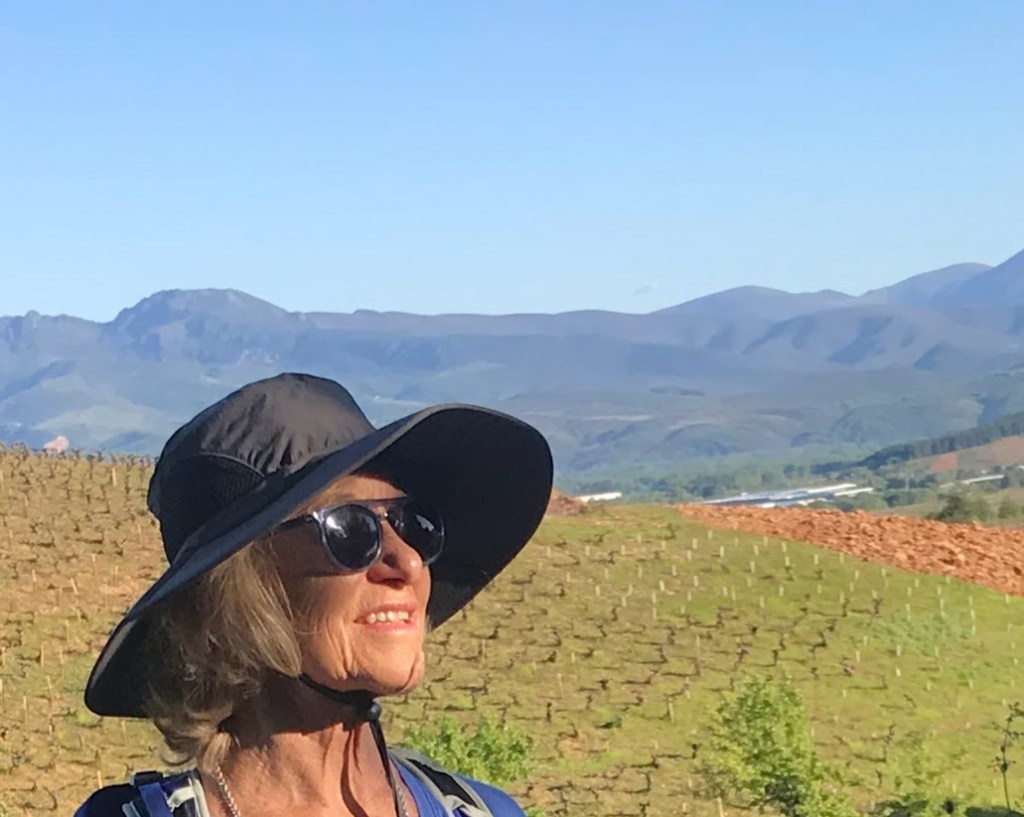
March 2019 – Intention
I walk and hear inside my head:
caminante no hay camino,
se hace camino al andar…[1]
I translate
for the friends
who will walk with me
part of the way:
Wayfarer, walker,
there is no path,
you make the path as you go.
We’re all voyagers, wanderers,
traveling in time,
a journey unknown,
until we make it up.
But, my friends, they
still don’t understand.
January 1968
The first time I left Buenos Aires, Argentina, where I grew up, it was January 1968. I was just 19 years old, single, so smart that it hurt, a trait I felt I had to hide. I thought the move to the U.S. would be temporary, just for one year. A lie to myself. My father bought me a round-trip ticket good for one year and booked a one-month return ticket for himself. “It will be like a long vacation,” I said to myself. One year later, in the U.S., my college boyfriend, Enrique, whom I had met in Argentina, became my husband. It took another seven years for both of us to return to Argentina — “Back home forever,” we said, and then we left again.
The first time I left, I left behind almost everything I knew and loved. My home, my father, my family, my friends. But most of all, the long hours of passionate chats or tête-à-têtes over a tiny cup, a demi-tasse of strong, dark coffee at one of my neighborhood corner cafés.
I would miss those moments when we sat in groups of five or six, crowded around the small round marble tables that should have seated only three. We bumped elbows, our hands moving up and down and sideways to make a point, interrupting each other as we shouted our truths.
Moments like that day when Germán, after swallowing the last drop from his double espresso, yelled: “Our military, they are in the pocket of the Americans.” The waiter, who was nearby, turned to look at him, raised his eyebrows and put a finger to his lips, a secret shush. Germán, his cigarette dangling from his half-open mouth, ashes strewn all over his gray patterned sport coat, let out a snigger. I was tense – who knew who around us was listening to our rants? It was early July 1966 and in June the Argentine military had overthrown the democratically elected government. There was talk that they planned to revoke academic freedom, the University autonomy that had been in effect since the university reform of 1918.
The first time I left, I left behind the fear. That day in the café I was nervous, but I was also excited, my face hot, I tried to get a word in but failed. I didn’t know how to project my voice. I also think now that my opinions were not yet well formed. I had passion but no depth. Next to me, Pablo, a skinny guy who wore, winter or summer, a roll-neck black sweater, and who was eating all the peanuts at the table, kept his voice down when he said, “The American imperialists invaded the Dominican Republic.” But Germán was undeterred, he signaled for another espresso and again yelled: “The military are a piece of shit, they are going to end the University autonomy, we have to act!”
I looked toward the door of the café for the blonde guy I had been dating for about half a year. He had a more analytical mind and a low inclination to scream, but he hadn’t arrived yet. We went out most of the time as a group. The word ‘dating’ didn’t exist at that time and in that place, we mainly ‘went out with someone.’
Germán’s voice rose a notch. I fixated instead on the glass of plain water, smaller than a juice glass, and the espresso cup and saucer the waiter set on the table for Germán. This time the little cup was half filled. It was a single, not a double espresso. The cup was smaller than his hand. His fingers were too big for the little handle, he clutched the whole cup in his palm. The cup was porcelain, the color of mayonnaise. It had wide smooth ridges all around and the top border was decorated with a thin gold guard. The saucer had a piece of chocolate next to the cup. I wanted to steal the sweet, I had already eaten mine. It was what I most loved when they served my coffee, the mini-sweet that came with it. Germán’s cup had a crack on the rim. For a moment I thought that he would cut his lip and stop talking, but he didn’t. I drank from my own glass of water.
[1] These are two lines from Proverbios y cantares X
 Maria Caponi
You must be logged in to post a comment.